I’m excited to share that we have launched an updated Pro & Teacher hosting plan for your Open edX® instances! We work very closely with our clients, and we listen to their feedback. As such, we have been working hard to improve our hosting plan after hearing that customization was too limited, the process to make changes to a theme was too time consuming, and that the price point was too high.
New features include a dedicated, secure instance that is backed up and monitored by the OpenCraft team, an unlimited number of online courses to serve a wide and diverse range of learners, a new UI console that provides a streamlined user experience (and includes a comprehensive theme editor for complete brand adherence), and the ability to create and support both custom domains and page creation for privacy policies and service level agreements.
With the new self-service platform, you can easily customize your own Open edX instance to provide a smooth registration and onboarding experience, as well as a customized look-and-feel to reflect your brand. You can easily install your instance and access it quickly. There’s no need for extensive technical knowledge or additional consultants. We have also introduced multiple pricing tiers based on the number of active users, which enables you to get all the Open edX platform’s essential features at a much lower cost. The details of the pricing tiers are outlined below.
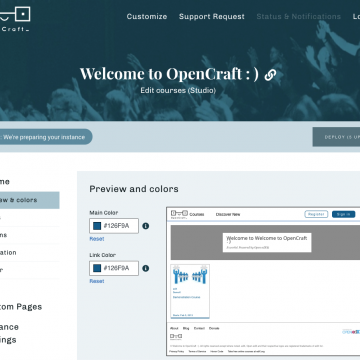
Here’s a look inside the platform.
A revamped user console features a comprehensive theme editor that allows thorough branding of the instance with options to customize colors, logos, buttons, navigation, footers and hero images.


Configuration options include custom domains:

Additionally, you can create custom pages, such as terms of services or policy privacy pages:

OpenCraft is offering two hosting plans: Pro & Teacher and Institutional. See our website for a full comparison of the plans.
Each plan:
The Pro & Teacher hosting plan provides all the essential features at an entry level price. It’s ideal for smaller organizations, teachers and even people who just want to try out the platform. It starts at just €39 / $43 per month for 50 users.
The Institutional hosting plan is designed for larger organizations with greater needs. If you want to scale up to millions of users, offer services such as e-commerce and mobile apps, receive expanded support and take advantage of OpenCraft’s experts for custom development support and services — then this is the plan for you.
Note: As of 2024 we no longer offer the Pro & Teacher Hosting Plan.
At OpenCraft, we work daily with top-tier universities. This probably isn’t all that surprising given that we specialize in developing and maintaining custom instances of Open edX, which is an open source course management platform that hosts Massive Open Online Courses (MOOCs) and online learning.
A massive number of institutions worldwide are members of edX.org, with more than 50 who are charter members. And they’re not just using the platform to power MOOCs, the original use case for Open edX. Today, they’re using Open edX to complement residential programs and offer blended learning experiences, especially in the face of the COVID-19 outbreak, because the platform's streamlined authoring experience allows instructors to easily shift to online courses and get them up and running quickly.
So, why are so many turning to the open source Open edX platform and, consequently, OpenCraft? After all, when it comes to learning management systems (LMS), Open edX is far from the only game in town, and prestigious institutions certainly have the budget to purchase proprietary software.
Universities have a dual humanitarian mission of providing high quality instruction and increasing our collective understanding of the world through research, but they still operate in a competitive environment. These institutions are constantly vying against each other for prestige, research funds and talented students. So, just as processes and business models evolve in the corporate world in response to competitive pressure, curriculum and research are constantly evolving at top-tier universities. This is especially critical in the wake of COVID-19, as higher ed institutions are now determining how they’ll continue instruction for the rest of 2020 and into 2021 — online learning will continue to play a key role.
Universities often need to expand, adapt and customize their LMS platform to meet their goals for learning innovation and research projects. Open edX is ideal for this purpose. It’s an open source, massively scalable platform that’s supported by an enthusiastic global community. And though its original use case, of course, was to power MOOCs, the platform has evolved into a powerful, flexible LMS.
For example, here’s some customizations we have done for our university clients:
A great example of a large-scale customization project is LabXChange. You can read much more about that particular project in our LabXChange launch blog post, but, briefly, LabXChange is an online science resource for students, teachers and the general public that we developed for Harvard University. It’s simple for anyone to build and share learning pathways (sort of like mini-courses) from smaller pieces of content that can be easily remixed and reused.
This was a two-year project built on Open edX, and it required extensive customization and new capabilities. This resulted in our contributing several major new Open edX features such as Blockstore (a new storage architecture), Content Libraries version 2, a new XBlock Runtime, anonymous platform access and a new visual assessment editor.
Having worked with dozens of universities over the past seven years, we’ve learned a great deal about how best to work with them.
You have to be patient. The academic world typically moves more slowly than the business world. We’ve had projects that took two years to come into place, from initial discussions to a signed contract.
Additionally, universities’ needs and goals change over time, which often affects the scope and timeline of our projects. Our iterative development approach allows us to be as nimble as our clients, so we can make changes, stay transparent and ensure that projects are delivered on time and with no surprises.
Finally, universities appreciate our commitment to open source and the larger Open edX community. They can expect that our solutions will be reviewed and approved by edX engineers and that they will align with edX's long-term roadmap. After all, it’s much less expensive to maintain new features and capabilities once a feature is merged into Open edX, because then it's maintained by edX and the community as a whole.
We really enjoy working with universities because they’re often pushing the boundaries of what’s been done before, giving us the opportunity to do creative, complex work. Plus, their high quality standards keep us sharp as we work to meet and exceed them, augmenting our expertise and increasing our ability to meet the challenges that all of our clients bring to us.
Learn more about our work with colleges and universities.
Photo by Christopher on Unsplash
From fall of 2016 through summer of 2018, OpenCraft worked closely with the edX for Business team and Arbisoft to build out and improve several crucial features for the Open edX Enterprise Service. These features still exist today and are ready for everyone in the Open edX community to use, extend, and build upon. We’ll describe them in more detail below. But first, let’s have a quick look at what Open edX Enterprise Service actually is.
The Open edX Enterprise Service code base adds support for a number of different use cases to Open edX, mostly in the realm of B2B. It is included in standard Open edX installations by default, but nonetheless a lesser known (or at least a less talked-about) component of Open edX.
It integrates with the ecommerce and course-discovery services. In fact, making use of all functionality provided by the Open edX Enterprise Service requires a working setup of ecommerce and course-discovery. The Open edX Enterprise Service code base also enables edX For Business.
In a nutshell, the service enables alternative ways of accessing course content that is hosted on an Open edX instance: It supports LMS integrations with third-party systems such as SAP SuccessFactors, Degreed, and Cornerstone as well as direct integrations via the Open edX Enterprise Service Catalog API. It also allows customers to purchase course seats in bulk so that they can provide course access to their employees via individual-use enrollment codes or direct enrollment for specific courses with discounts/entitlements. Through data pass-back and customer reports, employers can get information about “learner behavior and outcomes,” i.e., information about their employees’ performance in relevant courses.
As mentioned earlier, one of the key features of the Open edX Enterprise Service is support for integrating Open edX with third-party systems. Aside from general improvements to the code enabling these integrations, OpenCraft’s work in this area mainly focused on two systems, namely SAP Success Factors and Degreed.
OpenCraft expanded the existing integration for SAP SuccessFactors, adding features such as:
Our work also included implementing support for situations where specific learners no longer had a valid SuccessFactors account due to leaving the company or organization that had provided them with access to course content hosted on Open edX.
Integration for the Degreed platform did not exist when OpenCraft was first onboarded to the Open edX Enterprise Service project. We built this integration from scratch and applied large-scale refactorings to optimize code reuse between different integrations of third-party systems. Aside from making it easier to implement additional integration channels for third-party services in the future, these refactorings included making data-passback functionality asynchronous by allowing commands for transferring different types of data to run on separate worker threads as Celery tasks.
In addition to integrations utilizing specific third-party services such as SAP SuccessFactors and Degreed, Open edX Enterprise Service supports direct integrations via the service's catalog API. This increases flexibility for Enterprise customers by allowing them to connect their own learning management systems (LMS) to Open edX. However, not everyone wishing to make use of the Open edX Enterprise Service features has the ability to extend and/or modify their chosen LMS to establish an API integration.
To improve the situation for these types of Enterprise customers (i.e., to allow them to access and work with relevant data from the service with minimal upfront effort), functionality for transmitting data in alternative formats was added to the Open edX Enterprise Service. For example, instead of creating their own solution for obtaining reports from the Open edX Enterprise Service Catalog API, Enterprise customers can choose to have the platform send these reports to them in CSV or JSON format. Reporting configurations for individual Enterprise customers can be changed via the Django admin.
An important aspect to consider when integrating with external systems is that learners should be able to explicitly agree to their data being shared between Open edX and those external systems.
The service provides learners with this ability through Data Sharing Consent (DSC) features. For example, one of the early features that OpenCraft implemented was to ask learners to consent to data sharing when attempting to access courses in which they had been manually enrolled by their organization or employer, and to deny access to these courses when consent was declined. Similarly, in the earlier stages of the project we built functionality for requesting data sharing consent from learners when they attempted to redeem a course coupon provided by their organization or employer.
Aside from implementing and refining user experience for different use cases involving the concept of data sharing consent, OpenCraft also helped create a generic consent API and unified data sharing consent database model, which ultimately made it possible to extend DSC functionality to cover programs.
Creating a smooth experience for Enterprise learners also involved making a number of fundamental changes to existing functionality for registering, activating, and logging in to learner accounts on Open edX. Most notably, OpenCraft worked on creating and improving a special landing page for learners coming to the Open edX platform through an Enterprise workflow. This page allows learners to obtain various kinds of information regarding the platform itself, and the course or program in which they are about to enroll.
For example, when a new Enterprise learner creates an account with the platform, the landing page allows them to view the terms of service of the platform without leaving the registration flow. In a sidebar next to the elements of the page that the learner can interact with, the landing page also displays an Enterprise-specific welcome message as well as custom branding for the Enterprise customer that the learner is associated with. This feature is not specific to the registration flow; it is integrated with login and enrollment flows as well. Branding for individual Enterprise customers can be configured via the Django admin.
When the landing page is shown as part of the process for enrolling in a specific course, the Enterprise learner can view extensive information about the course on this page -- again without having to navigate to a different page. This is similar to the kind of information that the Open edX platform displays on the “About” page of a course.
In a later phase of the project, a landing page with similar capabilities was built for the use case of enrolling into programs. In addition to providing relevant information about the program in which the current learner is about to enroll, the Enterprise landing page for programs provides functionality for viewing information about each individual course that belongs to that program.
Another way the Enterprise learners' experience with the Open edX platform was made as smooth as possible was by minimizing the number of steps required to register or log in to the platform and to enroll in a course or program. To this end, OpenCraft built functionality for hiding irrelevant fields from the registration form and for skipping identity provider selection during the login process. OpenCraft improved the workflow for enrolling into courses by adding functionality for dynamically changing behavior based on whether a learner had already joined a given course: If the learner was completely new to the course, they would be taken to the Enterprise landing page. But if they had enrolled in the course previously, the system would take them straight to the course, never showing the landing page.
Lastly, to further simplify registration flows for Enterprise learners, OpenCraft implemented support for live validation of learner inputs on the registration page. This work involved extensive changes to frontend and backend code for user registration, and the results were visible not just to Enterprise learners but also to regular learners signing up for an account on the Open edX platform.
Want to learn more about our contributions to the Open edX Enterprise Service? Drop us a line and let’s chat. We’d love to hear from you.